How a Professional Trader Uses Backtesting: Tomas Byron on Premium Data
Tomas Byron uses Option Omega backtests as a data source, not a strategy finder. Here is his method, plus his views on volatility premium and calendars.
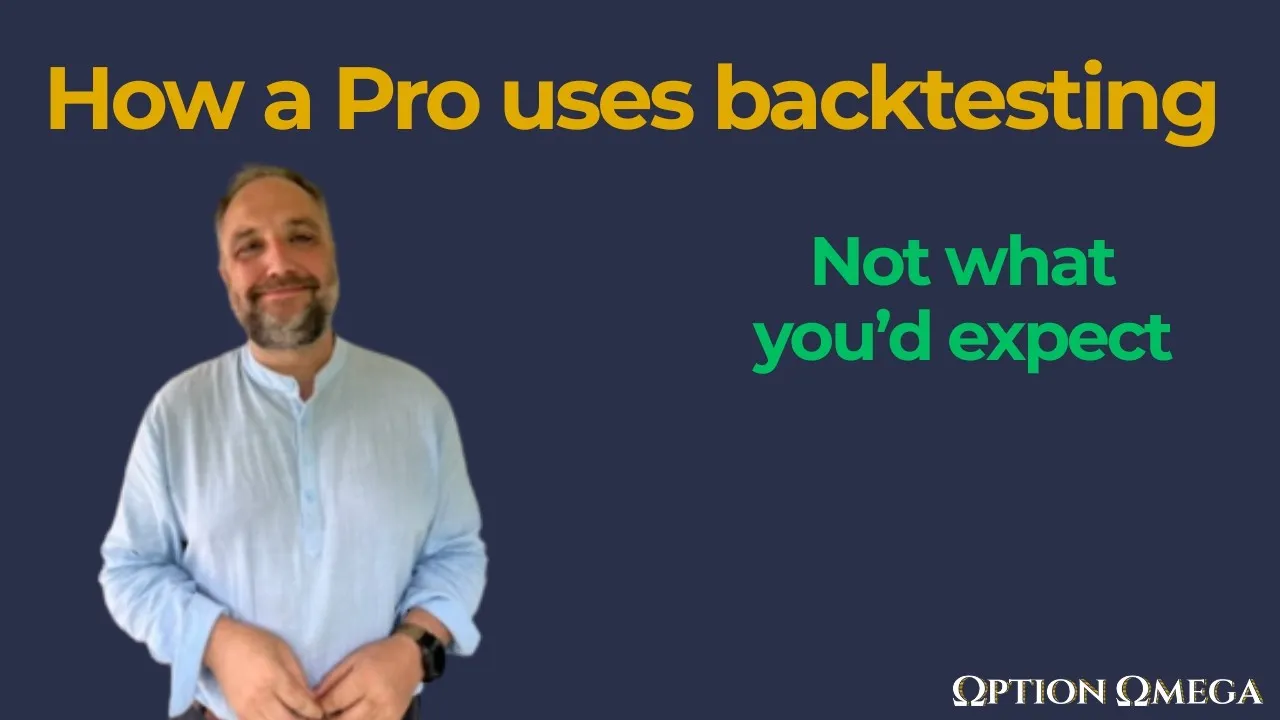
Troy has watched Tomas Byron use Option Omega differently from anyone else he’s seen, so he asked him to show how. Tomas uses backtests to collect data. He places the same trade every 10 minutes on a single weekday, exports the results, and studies how the premium behaves through the session. In his Tuesday double calendar example, that showed a tendency he uses to plan when to scale in.
Tomas has more than 20 years of experience in physical oil trading and investment banking, and now mentors traders. After the demo, the conversation with Troy moved to his views on the volatility risk premium, calendar spreads, the Greeks, technical analysis and risk, which he shared bluntly.
Using backtests as a statistical data tool
Tomas showed a deliberately simple example. It is not a real strategy of his. The setup:
| Setting | Value |
|---|---|
| Structure | Double calendar (puts and calls) |
| Day | Tuesdays only |
| Entry granularity | A new position every 10 minutes |
| Output | Results exported to Excel for further analysis |
He does not look at every day together. He looks at one specific day and puts similar dates in the same bucket, such as Tuesdays with a CPI release, so he compares “apples with apples.”
From there he tracks the progression of the premium from open to close. He looks at it two ways:
- Floating: following the position through the day without fixing an entry point
- Fixed: anchoring the entry at the open, an hour after the open, or toward the close
What the data showed
In this example, almost every Tuesday followed the same pattern. Premium tended to rise for about one hour from the open, stay flat during midday, then accelerate toward the end of the day. Tomas called it a tendency.
Tomas uses that to plan scaling. If he is putting on more than one lot, his read is to place some at the open, wait through the middle of the day unless the market moves hard, and complete the scaling near the close. Midday, in his words, puts money at risk “but no reward.”
He also looks at standard deviation and other statistics on the same trades across different dates, to see how a specific trade behaves relative to volatility and the underlying.
Why dynamic hedging is hard to backtest
Most of Tomas’s real trades are hard to test directly. He believes in dynamic trading, where hedges change and a position can “morph” into something else. He said that can be approximated with a portfolio of backtests, but it would mean closing and reopening pieces at the same time, which gets complex.
So he treats backtests as “not a finished product.” They give him clues about a trade’s potential.
Cutting the statistical wings
Some backtests show big one-off swings. On one trade that won about 65–66% of the time in the backtest, Tomas trims the extreme positive and negative outliers to get a rough picture of what to expect.
Troy agreed that this can be a good approximation for structures like butterflies and calendars, where some swings are liquidity blips in the marks. But he added an important caveat later in the conversation: on some strategies, the wings are real, and clipping them would hide exactly the risk that can hurt a trader.
Tomas also warned that stops need care with multi-leg options. A stale quote on one leg can trigger a fill that does not reflect the real market. He described cases where a platform showed a fill the broker later reversed, after the market had moved sharply.
Options traders do not trade the underlying
Tomas’s central point: option traders do not trade price. Price is one component. What they trade are all the moving parts, which rest on Black-Scholes, a formula that cannot be solved without the option’s price (that is, implied volatility). In that sense, he calls it useless.
Market makers who price structured products can spend years refining models. Retail option traders are market takers. Arguing whether a call is “too expensive” misses the point, in his view: you buy what the market offers, like oranges at the grocery store.
The volatility risk premium
In Tomas’s opinion, the only thing that’s certain in options is the volatility risk premium. He compares it to insurance: the premium compensates the insurer for risk, and it is better to insure houses after an earthquake than before.
He put the gap between implied and realized volatility for the S&P 500 at around 4.5 over the last 30 years. As he described it, market makers harvest it with variance swaps. Tomas argues retail traders can be more granular, staying close to the money and avoiding the distortions at the wings, as long as they have enough capital and manage through adjustments.
Calendars: beautiful in theory, ugly in practice
Many books say the best way to capture the volatility risk premium is a calendar (time) spread: the short front month decays faster than the long back month. Tomas’s warning is that calendars “look very beautiful” in a payoff graph at the start and “very ugly at the end.”
That is why he prefers the numerical view from backtests and optimizations over the graphical one. It shows how the trade behaved when volatility was at a given level, when it jumped or dropped, and when the market moved up or down.
Backwardation vs. contango
- Backwardation (front-month price higher than the back) works against a calendar, in his view. The short leg gains value and the long leg does not keep pace, so the trade can lose on the short and not make enough on the long.
- Contango is the opposite.
This is why he pushes back on the rule of thumb that calendars are a low-volatility trade. In his view, it depends on the term structure.
Managing by the Greeks, and why 0DTE is close to the underlying
Tomas says many traders who claim to manage by the Greeks do not really understand them. They may grasp delta and gamma but are lost on vega and on how the legs interact over time. Users can explore these relationships in Option Omega’s modeling tools.
On expiration choice, he thinks the middle works better than the extremes. Six or three months out, “nothing will happen.” On 0DTE, he says, you are essentially trading the underlying: the formula breaks down, and the margin on a 0DTE position is roughly similar to a futures position.
The upside of options, in his view, is that you can design a bet that is 60/40 rather than the 50/50 of a straight long or short. To judge whether that profile is fairly valued, he wants a history of the same bet in similar conditions, going back at least six months.
Knowledge, time and capital
Tomas’s other views, briefly:
- Rules come from trial and error. Science and trading both start with observation, not models.
- Technical analysis has no statistical edge, he argues. His evidence: major banks and trading firms do not have a technical analysis floor.
- Knowledge, time and capital. He says a trader needs all three, and that in most cases at least two are missing.
- “If you feel thrill when you trade… it’s not for you,” he said. In his view, a casino is more fun.
- React rather than predict. He compares trading to chess, where you respond to the market’s moves. The first entry, he said, is like a serve in tennis.
- Retail traders can be more granular than large funds. In his view, funds that size can’t work the vanilla options market this way.
Why static risk/reward ratios mislead
Tomas closed on risk. Even a 70/30 risk/reward is “not good at all” if it comes from a static calculation, because option risk changes as the trade evolves. He cited Nassim Taleb’s analogy: a single 10-meter jump can kill you, but ten 1-meter jumps will not. Models that sum the whole drop at once miss the stages in between, which is where you can stop the bleeding. His summary of a good trade: simple to put on, complex to think about.
Key takeaways
- Tomas uses backtests as a data source. Entering every 10 minutes on one weekday shows him how premium moves through the day.
- He compares like with like, bucketing similar dates such as data-release days.
- He trims outliers on some trades. Troy’s caveat: some wings are noise, but on other strategies they are the real risk.
- In his view, calendars depend on term structure. Backwardation works against them.
- Static risk/reward ratios do not fit options, in Tomas’s view.
Study your own trades
You can run the same kind of study in Option Omega: set a fixed entry interval, filter to a single weekday, and export the trade log for your own analysis. For a related look at double calendars and tail risk, see Dan Sheridan and David Romeo on correlation and double calendars. You can find Tomas at atmoptionsedge.ch.
Watch the full video: How a Professional Trader Uses Backtesting.
This post summarizes a conversation from May 2026 and is educational only. Options trading involves substantial risk.