Best Time to Sell SPX Spreads: Letting a 90-Day Lookback Pick the Entry
Eric O'Rourke's Trend Spread Engine ranks intraday entry times for 0DTE SPX credit spreads by 90-day win rate. Eric backtested its top slot in Option Omega.
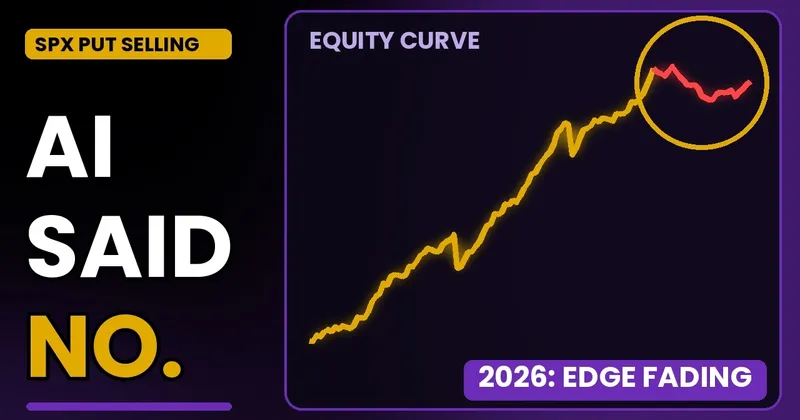
Sell a 0DTE SPX put credit spread at the same mid-morning time every day, with no filters, and the backtest averaged about $6 a trade over the year before the recording. Run it back further and it loses money. Yet inside that flat equity curve are six-month stretches where it worked well. Eric O’Rourke of Alpha Crunching built a tool that tries to spot those stretches as they happen.
His Trend Spread Engine (TSE) ranks intraday entry times by how often their credit spreads expired worthless over the last 90 days. In this video, Eric walks through how it works, then backtests its top-ranked slot in Option Omega: 91% wins on 35 put spreads and 12 for 12 on the call side over the same 90 days, through mid-April 2026. That’s a short window and a small sample, and Eric was open about what the tool does and doesn’t measure.
The problem: what to trade now
Eric’s 1-day, 3-day and 7-day strategies are mostly long-only, and in the recent market some have gone three to five months without a trade. He wanted a high-win-rate trade that fires often, so the law of large numbers works faster. His goal is about one good trade a day, without sitting in front of the screen.
First principles: the raw spread
Before showing the tool, Eric showed why it exists.
- Put side: a 0DTE SPX put credit spread sold at the same mid-morning time every day, no management, no indicators, held to expiration. It averaged about $6 a trade over the past year and loses money over a longer history. But the P&L curve rose for about six months, fell for a while, then rose again.
- Call side: the same idea with a call spread, collecting just under $1 of credit. It lost money for about six months, then made money for about six months.
Why would the same time work for six months and then stop? Eric’s view is that beyond bull and bear trends, there is intraday seasonality most traders do not track.
How the Trend Spread Engine works
TSE combines three things: time of day, which side to sell and strike selection.
- Trend check every 15 minutes. It runs from half an hour after the open to an hour before the close, which Eric says avoids the noise of the open and the “nuts” final hour. That is 21 checks a day.
- Two spreads per check. If the trend is up, it records two put credit spreads: one with a minimum 20-delta short strike and one with a minimum 15-delta short strike, roughly around the expected move. If the trend is down, it records two call credit spreads the same way.
- Weekly ranking. Every weekend, the Alpha Crunching report scores each time slot over a rolling 90-day lookback. A “win” means the spread made at least a penny, which usually means it expired worthless. The two spreads’ win rates are combined, and the top five times are ranked.
For the week ending April 17, the top slot was late morning. Over the prior three months it had about 64–65 recorded trades per spread with only five or six losses. For the two to four weeks before that, a mid-morning slot about an hour earlier had ranked first. As its recent results weakened, it slid to third.
TSE went live in December 2025. Eric was clear about its limits: it does not test width, stop losses or profit targets, and the credits posted in alerts are theoretical and often off. He said he has triple-checked the deltas and spot price. The report shows which times expired worthless most often, not how much a trade would have made. That is where Option Omega comes in.
Backtesting the top slot in Option Omega
Eric took every day the trend was up at the top late-morning slot and put those dates into a put spread backtest. He did the same with down-trend days for a call spread backtest. Both are 5 wide and held to expiration with no stop or profit target.
| Put spreads (trend up) | Call spreads (trend down) | |
|---|---|---|
| Entry | Top-ranked late-morning slot | Top-ranked late-morning slot |
| Short strike | 25 delta (more aggressive than TSE’s 20) | not stated for the backtest (his call template uses 20 delta) |
| Gap filter | Skip days gapping up more than 0.5% | Skip big gap days |
| Trades over 90 days | 35 | 12 |
| Win rate | 91% | 100% |
| Expectancy | about $45 per trade | not stated |
On the put side, Eric noted the risk is roughly four to one. He combined both into one portfolio covering roughly the start of 2026 through mid-April, 47 trades in all. OO’s host said it looked a lot better than many of the 2026 backtests he’d seen. With a 5-wide held to expiration, there was no stop loss or profit target to dial in, only position size.
Why skip the gaps
The gap filter is something TSE does not do on its own. Eric’s reasoning: when the market gaps, early knee-jerk moves can flip the trend several times, so he wants the market to establish itself first. That is also why he thinks the late-morning slot moved up the rankings. In his view, war headlines made mornings too choppy.
In an earlier test he described, trading one spread at a time, versions with and without the gap filter both made about $3,000, but one needed about 15 more trades to get there. For Eric, that meant about the same money with fewer trades and less volatility. If gaps settle down, he expects the filter to simply skip fewer days.
Eric and OO’s host also talked through why cutting losers matters so much here. With a high win rate and a lopsided payoff, collecting about $1.00 of credit to risk about $4.00 on a 5-wide, removing one loser is worth several winners.
How the rankings shift
Asked whether a top time ever falls off the list entirely, Eric said the ranking system is still new, so he hasn’t tracked that. What he had seen by the time of the recording: no afternoon time had made the top five. The top slots clustered from mid-morning to midday; he hadn’t seen one later than that. The jump of a full hour at the top, as happened in the week of the recording, was the first he had seen.
OO’s host floated one approach: since the report lists five times, not one, a multiple-entry trader could trade the whole top five and let the list update itself each week. Eric said daily updates may come eventually.
How Eric executes with Option Omega
Eric runs two Option Omega automations built from the backtests, one for puts and one for calls. He keeps them paused and uses them as templates. When the top-slot alert comes in and he wants the trade, he opens the matching automation and uses the trade now button. The strike selection is already set.
- Put side: 25 delta, which he expects to collect about $0.75 to $1.00
- Call side: 20 delta, also about $0.75 to $1.00
On gap days, when he does not take the mechanical entry, he may day-trade it instead. Each alert also posts the 15-delta strike levels for the other top-five times. For the top slot, Eric said that level had expired worthless about 92% of the time over the prior three months, which he stressed doesn’t mean it will. If the market pulls back, he can sell a spread below that level, or for a better credit, and still use the template to place it.
Smaller accounts: XSP
Because the trade holds to expiration with no exits, OO’s host pointed out the concept could be run on XSP as a 1 wide, which is the equivalent of a 10 wide on SPX, at perhaps a quarter or a fifth of the allocation. He suggested including fees and slippage, which are higher on XSP. For more on that, see XSP automation: what to know first.
Key takeaways
- In Eric’s raw backtest, a fixed daily entry time worked for months, then stopped. The spread averaged about $6 a trade over the year before the recording.
- TSE ranks times by 90-day win rate and updates weekly, so the best slot can change.
- The top late-morning slot backtested well over a short window: 91% wins on 35 put spreads and 12 for 12 on call spreads in the roughly 90 days through April 17, 2026, with gap days skipped.
- Skipping gap days made about the same money with fewer trades in Eric’s testing.
- Eric uses paused automations as templates to place a pre-set spread in one click when a signal fires.
Test entry times yourself
You can run the same kind of check in Option Omega: backtest a credit spread at several entry times, compare recent windows against the full history with the backtester and Optimizer, and save a version as an automation you trigger yourself. Start a free trial. Alpha Crunching is at alphacrunching.com.
Watch the full video: Best Time to Sell SPX Spreads? We Let the Data Decide (Alpha Crunching + Option Omega).
Backtest results are hypothetical and do not guarantee future performance. Options trading involves substantial risk.