Tom Sosnoff on 0DTE, Automation and Where Retail Options Trading Is Headed
Tom Sosnoff tells Dan Sheridan why he barely trades 0DTE, why 30+ days is his wheelhouse, and how he thinks about automation and position size.
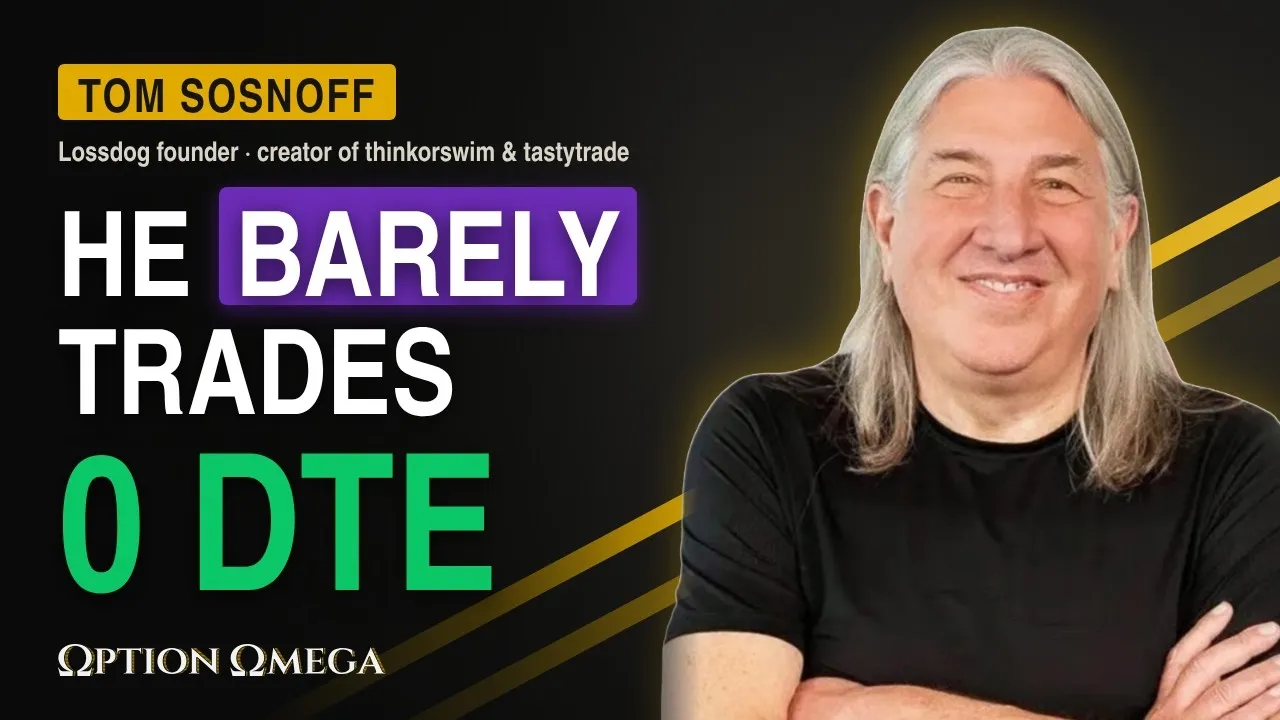
Tom Sosnoff, founder of thinkorswim, tastytrade and now Lossdog, is very active in the markets. Yet he told Dan Sheridan he uses 0DTE much less than you’d think and doesn’t trade SPX. His wheelhouse is 30+ days to expiration, with 45 days “being perfect.”
(Note for posterity: The video was published in June 2026. The positions and 2026 results below are as Tom described them at the time.)
“Priced to perfection”: why he is short the market
At the time of the interview, Tom was short QQQ and the NASDAQ, a position he had held from lower prices and that was down money overall. His view was not that a crash was coming, only that the market was “priced to perfection” and due for a reasonable selloff. A 10% drop in the NASDAQ, he said, “would be a good number for me.”
He was careful not to get excited about one down day. In his words, this has been a buy-the-dip market for about 17 years, and traders have not been rewarded for jumping on the downside.
Size is how he survives
Dan asked how a contrarian handles being wrong. Tom’s answer was simple: he tries to keep his trade size in check. If he controls size, he said, he’s okay with pretty much anything.
The trades that get away from him are the ones where he didn’t. Micron was his example: he didn’t control his trade size very well and let the trade get away from him a little. He said he still makes that mistake, just not as much as he used to.
Dan said he often sees retail traders triple their size after a few weeks of making a little money, and that it usually doesn’t end well. Tom agreed: “That never works,” because there is too much randomness in results. In his view, a trader can be mechanically correct, optimize everything and be strategically spot-on, and occasionally “the other side wins.” That’s easier to accept when size is in check.
Why he barely trades 0DTE
Tom is glad 0DTE exists, but it plays a small role in his own trading. Two reasons:
- Edge. The main one. He feels he has little or no edge in same-day options.
- Attention. He gets busy at different times of the day and can’t manage 0DTE positions well.
He prefers longer duration: 30+ days to expiration, with 45 days “being perfect.”
0DTE also came up when Dan asked why he doesn’t trade SPX. Tom wasn’t entirely sure, but guessed it’s because he mostly stays away from 0DTE and, for whatever reason, likes SPY a little better. Dan raised SPX fees as his one complaint about the product. In Tom’s view, those fees are central to Cboe’s business, so he doesn’t expect them to come down. With SPY, he said, “there’s no fees.”
Automation and the strategy behind it
Dan mentioned that a lot of Option Omega users automate 0DTE trades, and said he liked it when it comes with good risk management. Tom’s position:
- Automation for mechanics and parameters: fine with him.
- Automation as discipline: “totally fine,” though it’s not what he would do himself. He pointed out that high-frequency firms use automation strictly for discipline and mechanics, and thinks retail traders can do the same and be very effective with it.
- Automation itself isn’t an edge. It can carry out a strategy’s rules and help with discipline, but automating those rules doesn’t establish that the strategy has an edge.
Tom put his skepticism this way: “I just don’t think some bot can trade for you and make you money.”
Dan added that automation needs “a good pilot,” someone who understands what they’re doing. Automated trading in Option Omega is built around that idea: traders set the rules from a strategy they’ve backtested, and the automation follows those rules.
Prediction markets and the fee problem
Tom is very bullish on the listed financial space as a whole. He thinks new technology and AI level the playing field more than ever, and new stocks and products keep arriving.
He’s also been a fan of prediction markets for a long time. He built the Small Exchange and wanted to move in that direction, but couldn’t convince his teams, who didn’t think it would receive regulatory approval. It still bothers him that they were early and missed it.
He uses them less than he probably should, though. His problem is cost:
| Market | Tom’s comparison on $100,000 traded |
|---|---|
| SPY options | Much lower costs in his example |
| Prediction markets | About $2,000 in fees, by his estimate |
He calls that a negative edge, and says that until those fees come down, prediction markets are less attractive to him. Still, he likes that they let you bet both sides, unlike most gambling, and that you can effectively assign a delta to any bet.
How he trades strangles
Tom is still short plenty of strangles, though maybe not as many as a year ago. He doesn’t think his strategic approach has changed in 10 years. What changes is how he leans:
- More aggressive selling puts on things he feels are oversold. He sometimes sells naked puts too, for example on beaten-down software stocks.
- Less aggressive selling upside calls in what he called a runaway market.
- Never legging in. He usually goes one-to-one and always sells both sides at the same time. “Every time I leg a strangle, I screw it up,” he said, because you take the good side off too early and let the losing side run.
Skew: the SpaceX strangle
He sold strangles on SpaceX in its first couple of days of trading. A stock like that has heavy call skew, so premium didn’t come in on the way up. Once the stock reversed from the 200s to around 180, premium got crushed and he covered for a good trade. He noted that’s the opposite of how skew behaves in the S&P.
On liquidity, he said IBM markets were 80 cents wide that morning while SpaceX was two cents wide.
Volatility vs. charts
Tom says he has built some of the best charting platforms that exist, yet he doesn’t use technical analysis himself. He calls it “a look in the rearview mirror.” He believes price is random, so looking backward means little to him. Implied volatility, he says, gives a forward look at the expected move, and that matters most to him.
He still supports anyone who uses charts if it keeps them engaged and helps them feel better about their decisions. Dan’s take: the number one goal with a new trader is to keep them engaged long enough to get to six months.
Tom thinks what most retail traders know is market direction, not volatility, so they have to go with what they know at first and then figure out how to work volatility-based strategies into it. Besides that, the biggest struggles he sees are the nuanced know-how required and simply finding trade ideas.
What he traded in 2026
Since the start of 2026, as of the interview:
| Category | Most traded or notable |
|---|---|
| ETFs | SPY and QQQ, by far |
| Index futures | ES and NQ (or MES and MNQ) |
| Metals | Gold and silver, mostly futures options, using the micro contracts |
| Bonds | ZB (30-year) and ZN (10-year); bought every dip |
| Best performers | Robinhood, IBM, gold, SPY and NASDAQ |
| Biggest loser | Micron |
| Mixed | AMD (mediocre), Nvidia and Tesla (okay) |
Buying beaten-down stocks worked on Robinhood and IBM but not on Netflix or Uber, and he did poorly on AI stocks he thought were overpriced that kept going higher. He also trades minis and micros overnight. “It’s a sickness,” he joked.
What’s next
Tom says he is never retiring. He and Scott are building Lossdog, which he described as covering everything from career and portfolio optimization to following trades and prediction tools, and they are working on projects with bigger firms. He said they have about 10 years of plans ahead, and that they are going deeper into retail, not leaving it.
Key takeaways
- Tom uses 0DTE much less than you’d expect because he feels he has little edge there; his wheelhouse is 30+ days, with 45 days being perfect.
- He credits size control with how he’s survived. Micron, his biggest loser of 2026 at the time, was his example of letting size get away from him.
- Automation can help with discipline and mechanics, but automating a strategy doesn’t establish that it has an edge.
- Fees limit how much he uses prediction markets. In his example, trading $100,000 in prediction markets cost about $2,000 in fees—far more than his SPY options comparison.
- He opens both sides of a strangle at the same time, and leans toward selling puts on names he feels are oversold.
- He looks to implied volatility over charts as a forward-looking measure.
Testing the rules before automating them
Tom’s view of automation as a discipline tool lines up with how OO is meant to be used. In Option Omega you can backtest a strategy across years of data, see how position size changes the drawdowns, and then automate the rules you tested. Start a free trial.
Watch the full conversation: Tom Sosnoff on 0DTE, Trading & Where Retail Is Headed.
This post summarizes a conversation from June 2026 and is educational only. Options trading involves substantial risk.