Moving From Risk to “Risk-Free”: Tomas Byron Explains the Condor Nest
Tomas Byron explains the Condor Nest, which starts with a double calendar and converts it into an iron condor to change the risk profile and provide margin relief.
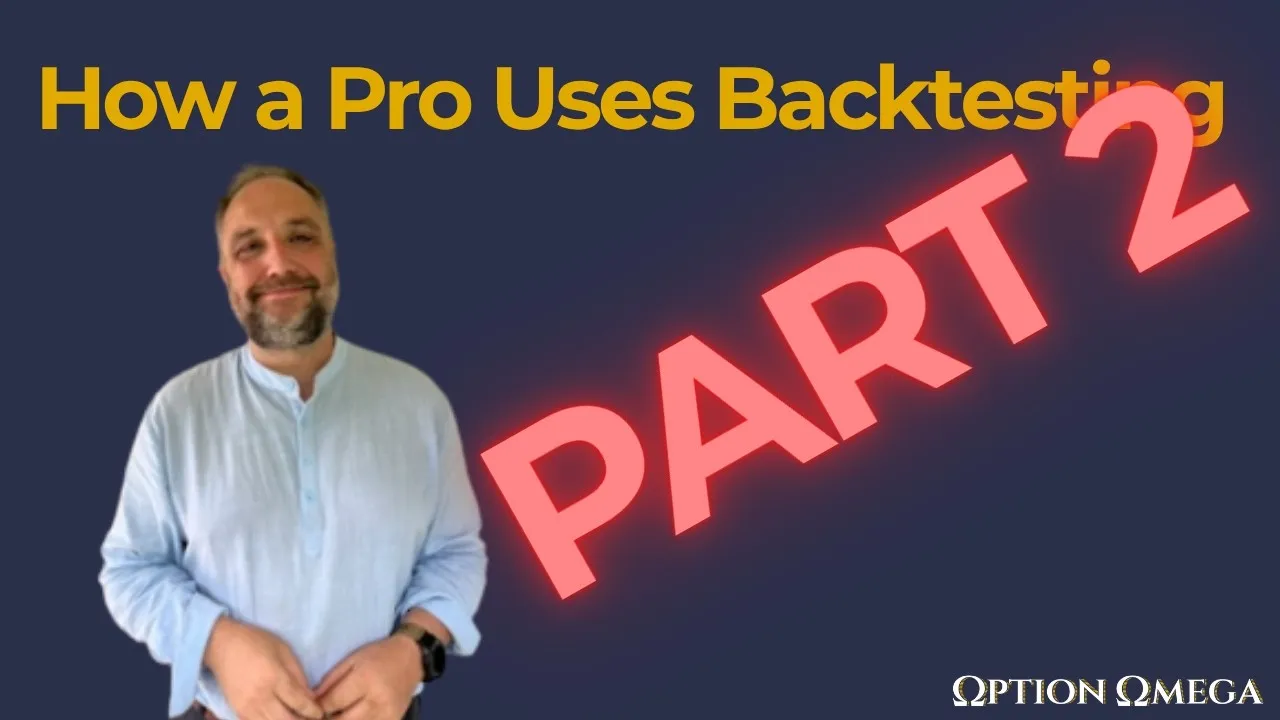
Tomas Byron does not open iron condors from scratch. He calls that “a very bad strategy.” Instead, he opens a double calendar, waits for it to reach a target, and then converts it into an iron condor. In the example in the video, he showed the converted position had a projected minimum profit of about $310, and the margin he started with came back to the account.
He calls the method the Condor Nest. In this second conversation (after Part 1 on how he uses backtesting), he walks through the idea, the problem it solves, how he uses Option Omega to track time spreads, and why the recent end of the $25,000 pattern day trader rule matters for it.
Why he avoids iron condors from scratch
An iron condor is two short verticals: a call spread above the market and a put spread below it. Tomas’s problem with selling one outright is the shape of the trade.
- Win rate versus risk. In his framing, a typical iron condor might win about 90% of the time, but the risk/reward means the losing trades give back a large share of the gains. Traders get confident after a winning streak, increase size, and then take the big loss.
- Gamma. He describes vanilla iron condors as having “horrible gamma exposure” that matters from day one, not just near expiration.
- Slow profit. Profit matures slowly, so a lot of money is parked for a long time with a lot of risk.
- Adjustments. When the market moves toward a short strike, the trade forces adjustments, or it gets hit hard about 10% of the time with no good way to adjust.
Why time spreads are hard
Time spreads, such as calendars and diagonals, collect time decay faster. Tomas’s goal for a nondirectional strategy is to capture theta, and he sees time spreads as the best tool for that. But he says very few traders master them.
His reasons:
- There are many moving parts. Key among these are which expirations to pick, the volatility of each, and how they interact.
- The risk graph in broker or analysis software does not show what really happens to a time spread. In the closing minutes he went further, saying the tools people look at for time spreads are wrong, including the graph.
- Many traders time calendar entries off VIX. His view is that unless you trade 30-day options at the money, VIX measures something different from your trade. He compares it to checking a North American weather forecast to decide whether to carry an umbrella in one part of Chicago.
How he uses Option Omega for time spreads
Tomas is a big believer in the trade behavior being the ultimate teacher. Before he trades, he records how that exact calendar has been priced. He uses Option Omega for this, as shown in Part 1: in his workflow, he uses OO to validate ideas, analyze price behavior over time, and look for abnormalities. Once he has a baseline, he can then compare the trade’s behavior to real-life volatility.
That process is tedious, he admits, but without it he considers talk about high or low volatility pointless. This is the same kind of data sourcing he walked through in the Option Omega backtester in Part 1.
The Condor Nest mechanic
Tomas stressed that the numbers on his slides are an example, not settings to reverse-engineer. The course gives specific guidelines, which he says are a starting point, not set in stone.
| Step | What happens |
|---|---|
| 1. Enter | Tomas opens a double calendar, with a put calendar below the market and a call calendar above it. He prefers this over a double diagonal to keep the initial structure simpler. |
| 2. Size | He starts with two lots; he’s usually estimating a target of $2,000 to $3,000 in margin at the time of the presentation. |
| 3. Wait for the target | He looks for an opportunity to convert the position at breakeven, reduce the original entry cost, or lock in a projected profit. |
| 4. Convert | Once his target is reached, Tomas converts the position into an iron condor. In his example, this not only changes the risk profile but also provides margin relief. |
| 5. Redeploy | Tomas can then use the released buying power to open another nest at a different price or add to the existing one if he wants to. |
Two lots, rather than one, give him choices at conversion: a parallel iron condor, a bearish condor, a bullish condor, or one of each.
What the converted position looks like
In his example, the risk graph of the locked position was almost flat compared with a normal iron condor. Tomas used the following figures to explain the choices available in his example:
- Projected minimum profit after conversion: about $310.
- Value available from closing at that point: about $530.
- Projected profit if the market finished at the center: about $1,300.
- Another exit illustrated in the presentation: about $490.
Tomas pointed out that holding the position leaves some of the current profit at risk, with the potential to earn more if the market finishes near the center. He thinks holding is worth it because of the gamma. Instead of getting worse as expiration nears, the profit zone grows toward the center over time.
The width of the locked range depends on conditions. When he prepared the presentation it was around 30 to 40 wide, and he said members locked 100-wide condors when volatility was wild.
How Tomas changes the risk profile
Tomas values being able to change the position as conditions change. If a Fed meeting is coming up and he no longer wants the exposure of the time spread, he can convert it to an iron condor. If the market stays put, he can reverse that conversion. If it moves, he can leave the condor in place and consider opening another nest at a different price.
The slow pace of the converted condor, he argues, works in the trader’s favor: there is time to think, build another nest, or cash out. How fast a lock happens depends on volatility; he mentioned a member who locked a condor at breakeven in less than a minute one time—an extreme example, but possible.
Start with the slow car
Tomas often looks to enter Friday at the close or Monday at the open, though he evaluates other potential entry times as well. In his mind, expiry is a far bigger choice because options prices and volatility can behave very differently in an intraweek trade versus a multiweek trade.
The comparison he uses is simple: you can learn to drive in an F1 car, but it’s generally not a great idea. It’s often better to start in a humble Honda or Toyota and learn the ropes. Safety first, rally car later! In options parlance, further-out expirations often give more time and potentially a gentler adjustment horizon. Nearer expirations can produce gains or losses faster, making them more intense to manage.
Tomas’s “dream” case: no conversion needed
What Tomas is often after, his “best case,” is the market sitting at the center of the DC and staying put—which he gives a very low possibility. With consideration to his strike and DTE selection, because this is not the dream for every day, in these rare cases Tomas doesn’t convert. Troy noted that the same thing can happen on a 0DTE trade.
The PDT rule and leverage
With the PDT changes underway in Spring 2026, Tomas discussed what that could mean for smaller accounts. In his approach, margin relief creates room to open another nest, though that also means taking on another position. He emphasized spending time in simulation and learning how the trades behave. The rules in effect still depend on the broker.
The course, briefly
Tomas offers a paid course for $599. It includes extensive documentation, user guides, pre-selected trade setups, and thinkorswim and IB template spreadsheets. Additionally, he runs a Discord where members share trades. He’s been teaching for about three years, and this course came out in early 2026.
Key takeaways
- Tomas prefers starting with a double calendar, then converting when the position reaches his target.
- The conversion changes the risk profile and, in his example, provides margin relief.
- He uses OO to validate ideas, establish a pricing baseline, and look for unusual trade behavior.
- He favors learning with further-out expirations, which can offer more time to observe the position and consider adjustments.
Test calendars yourself
Tomas uses OO to get a better understanding of the trades he’s considering. By looking at pricing over time and comparing entry times and expirations, he builds a baseline to help validate his ideas and spot unusual behavior.
Start a free trial to try it. To learn more about Tomas and the Condor Nest, visit atmoptionsedge.ch.
Watch the full conversation: How a Pro Turns Calendars Into Free Iron Condors (Part 2).
This post summarizes a conversation from Spring 2026 and is educational only. Options trading involves substantial risk.