JJ Kinahan on Position Sizing and the 2 Spreads to Learn First
Cboe's JJ Kinahan tells Dan Sheridan why new traders should learn verticals and calendars first, start with one contract, and stay inside their risk band.
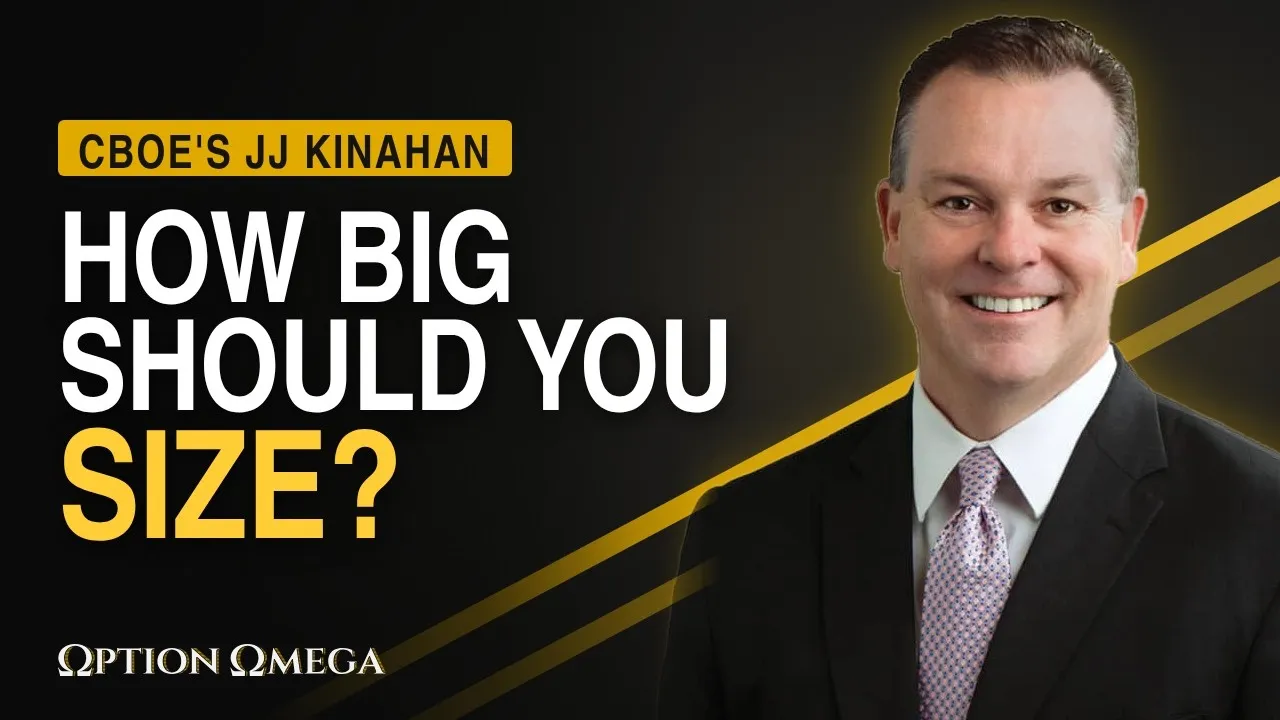
JJ Kinahan’s first lesson on the Cboe floor was not about getting rich. On his first day trading, he was told that if he was even after six months, he was welcome to stay. If not, it had been great knowing him. Four decades later, that is still what he tries to tell retail traders: learn how to break even before you try to make a fortune.
Kinahan traded in the pits for 21 years, ran education at thinkorswim and TD Ameritrade, served as CEO of tastytrade, and at the time of the interview had recently joined Cboe. Dan Sheridan wanted his view, from both the pit and the brokerage side, on what newer retail traders need to learn about themselves as much as about strategies, and on how Cboe is trying to reach them.
From clerk to OEX market maker
Kinahan came to Chicago in January 1985 and clerked at the CME, the Board of Trade and Cboe. As a clerk he made $700 a month. When he started trading, he paid himself $1,000 a month and worked as a bar bouncer on weekends so he would not have to take money out of his trading account.
He traded mostly in the OEX pit (the S&P 100), which he describes as the largest pit in the world at the time, with about 600 people in it. He started as a scalper. He made a little money in the 1987 crash, which let him buy out his backer and trade for himself.
Volatility, skew and the two spreads to learn
Before the 1987 crash, Kinahan says, put skew and call skew did not really exist. Today, in his words, any options chain shows puts priced at a higher volatility than calls. His explanation: the market “goes up the stairs and goes down out the window,” so traders expect volatility to rise when the market falls.
Over time he became more of a volatility trader, often using calendar spreads: selling volatility in the front month and buying it in the back month. A volatility pop helps that position, but, as he put it, “you have to pay for that every single day.”
His core advice for newer traders is short. Learn two spreads:
| Spread | What it is |
|---|---|
| Vertical spread | Two options, same expiration, different strikes |
| Calendar spread | Two options, same strike, different expirations |
His point is that any spread, no matter how complex, is some combination of verticals and calendars.
Find your risk band
Dan asked where Kinahan sat between contrarian and delta neutral. Kinahan’s answer was about risk tolerance. Tom Sosnoff, he says, has a much larger risk tolerance than he does. Tom believes in reversion to the mean and can sit through a long daily grind of losses before a big down day pays him back. Kinahan says most people, himself included, have more trouble stomaching that.
He does not believe in the advice “don’t have emotion.” It is money, so you will feel something. What he found instead is a band:
- Inside his band, he has little emotion and makes good decisions.
- Outside it, emotion creeps in and his decisions get “really, really poor.”
- He tries to stay inside that band as much as he possibly can.
Kinahan says learning this about yourself is every bit as important as learning strategies, if not more.
Sizing: start with one contract
From his years running education, Kinahan sees the same pattern in newer traders. They want to trade 10 contracts and put all 10 on at once. Experienced traders, he says, split it up, for example two contracts entered five different times. In his view, when the size is smaller and the trade moves against you, the move becomes an opportunity instead of a panic.
His advice to his own children:
- Start with one contract.
- Go to two contracts.
- Keep building one or two contracts at a time until you find the level where you are comfortable.
Paper trading helps you learn the mechanics, but he jokes that he is one of the greatest paper traders in the world: he can lose $50,000 on paper without flinching, but down $20 in real life, he hates everyone he has ever met.
Market orders, stop orders and alerts
Dan raised a common question from 0DTE traders, especially those running multiple iron condor entries in a day: what about the days when many stop orders get hit at once on a sudden move?
Kinahan’s answer depends on whether a trader can watch their trades. If they can, he recommends setting an alert before the exit point to leave time to think. His example: sell something for 70 cents and plan to exit at $1, then set an alert at 90 cents. That gives a few minutes to decide whether you still want out. If work or family means you can’t watch, he said, then use a stop order.
Either way, he stresses discipline. When he says he is getting out at a price, he gets out. “Never say this time is different,” he says. The only thing different, in his telling, will be that you lose more money than ever. One of the best pieces of advice he’s heard, in the polite version: don’t eat like a bird and poop like an elephant. Don’t make dimes and 15 cents and lose dollars.
Why retail grew to about half of SPX trading
Kinahan credits the meme stock era with getting many younger people to look at their 401(k)s for the first time and learn that options offer more than buying an out-of-the-money call.
His numbers for SPX: about 18–20% retail around 2017–2018, and about 50% at the time of the interview. He credits 0DTE options for part of that growth.
He pushes back on critics of young 0DTE traders. Options cost fewer dollars than stock: if an option costs $4, the most a buyer can lose is $4, while a $200 stock can lose far more. And in his view, people have a better sense of where the market will be at the end of today than in six months, which helps explain the popularity of short-dated options.
Dan added his own change of view. He has done teaching with Option Omega, which has a large 0DTE community, and says that if you asked him today about the risk management of 0DTE traders, he would call it “stinking phenomenal.”
Automation: go small and build trust
On automation, Kinahan is open but careful. He has tried some automated trading and is not as comfortable with it yet. His advice is the same as for everything else: start small and build trust in the system.
Where it helps most, in his view, is discipline. Most people are not good at following a system, and automation helps them follow it because the rules are programmed in. He called it a great way to take emotion out of the equation. When traders say “if it weren’t for those three or four trades,” he asks why those trades went wrong. His answer: those were the ones where the trader wasn’t disciplined.
What Cboe is building: XSP prediction markets and the Plus Zone
Kinahan says one of the reasons he joined Cboe was to lead prediction markets. As of the interview, Cboe had launched prediction markets on XSP, which many call the mini S&P and which is one-tenth the size of SPX.
Alongside traditional yes/no contracts, Cboe has the Plus Zone: a $1-wide vertical spread quoted all day. The goal is to get people thinking in spreads. New traders often see single options with wide markets, while the spread market itself may be only a penny or two wide. In Kinahan’s words, spreads define your risk and probabilities up front.
Not every broker offered them yet at the time of the interview. Kinahan said Schwab was about to come online, and that Cboe planned to expand the product to the Dow, the Mini Russell and the Mag 10.
Mag 10 and XSP for smaller accounts
Kinahan also pointed to Cboe’s Mag 10 product, which tracks 10 of the market’s largest stocks (think Amazon and the chip names), as worth a look. For newer traders intimidated by SPX at around $7,500, XSP trades at about $750, one-tenth the size, with less premium at risk. He said XSP volume was up about 20% so far in 2026. For product education, he recommends the Cboe Options Institute.
If you are considering XSP, see what to know before automating XSP and how we handle XSP in backtests.
Key takeaways
- Breaking even comes first. Kinahan’s first-day rule was to be even after six months.
- Verticals and calendars are the two spreads he’d learn first. In his view, every other spread is built from them.
- He knows his risk band and says he makes better decisions inside it.
- His sizing advice starts with one contract and scales up one or two at a time; experienced traders, he said, split large ideas into several entries.
- He prefers alerts before an exit when a trader can watch, and stop orders when they can’t. Either way, he sticks to the plan.
- He’s going small with automation first, and sees its main value in discipline.
Testing spreads and sizing in OO
Kinahan’s advice keeps coming back to defined risk, small size and a system you follow every time. In Option Omega you can backtest vertical spreads and calendars with different stops and sizing, and compare how those choices changed the results before deciding whether to automate a strategy.
Watch the full video: CBOE’s New Head of Retail Trading: JJ Kinahan on Sizing, and the 2 Spreads You Need.
This post summarizes a conversation from August 2026 and is educational only. Options trading involves substantial risk.