SPX Iron Condor Power Hour Backtest: Is 0DTE Dead? (Part 1)
Matt re-runs a 0DTE SPX iron condor sold in power hour on Mondays and Fridays, 10 wide with a 50% profit target and 3:52 exit. Results as of February 2026.
A lot of traders have been saying 0DTE is dead. Matt from Option Omega has heard it too, and he said he’d been in a bit of a drawdown himself. So instead of arguing, he re-ran a short-premium 0DTE backtest first shared on the OO show in June. His spoiler for this one backtest: “it’s not dead.” It sells an SPX iron condor in power hour on just two days a week, and at the time of the video it had done well since it was shared.
This is Part 1 of the “0DTE Is Dead?” series. The other parts test an iron butterfly with a VIX and RSI filter, a non-opening-range-breakout iron condor, and all three combined as a portfolio.
The setup
The backtest came from a trader named Mark, who shared it on the OO show in June. It’s about as simple as a 0DTE trade gets.
| Setting | Value |
|---|---|
| Underlying | SPX, 0DTE |
| Structure | Iron condor |
| Entry window | Power hour, the last stretch of the trading day |
| Days | Mondays and Fridays only |
| Short strikes | 40 delta |
| Width | 10 wide |
| Minimum premium | $4.00 (option price, so about $400 on one condor) |
| Profit target | 50% |
| Timed exit | 3:52 ET |
| Stop loss | None |
| Slippage | Included on entry and exit |
| VIX | Does not enter when VIX is high |
Why there is no “two hits” on the profit target
Matt usually talks about requiring two hits of the profit target before it triggers. The point of two hits is to avoid counting a fill that only happened in an illiquid moment.
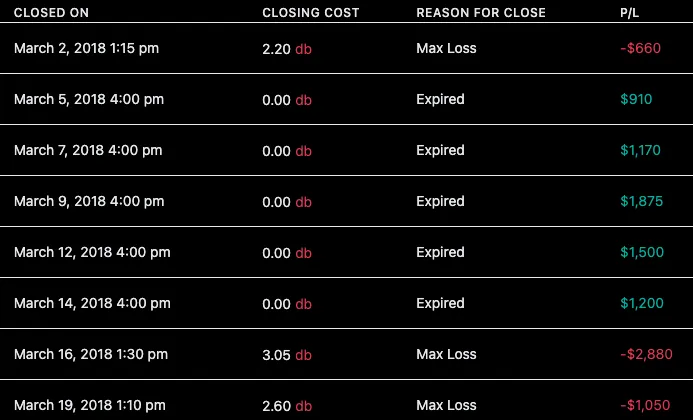
On this trade it’s left off, and Matt used the trade log to show why. Late in the day, this is a close-to-the-money spread, and those are very liquid. Replaying a couple of the profit-target exits, the underlying barely moved after entry, about a point in one case, while the spread worked its way to the target. Matt considered those legit fills, so in his view a second confirmation added little here.
How the trade wins and loses
This is an iron condor. It does best when SPX doesn’t move much between entry and the close. Modeling the trade in Option Omega shows the shape. In a typical short iron condor, the trade is short vol/short movement.
There are two ways out:
- The spread decays to the 50% profit target.
- The timed exit at 3:52 closes whatever is left. That can still be profitable, but it isn’t guaranteed to be.
It gets rough when SPX makes a big late move. Matt pointed to a day about a week before the recording when SPX moved about 30 points. His verdict: “Not great, Bob.”
In exchange, Matt called the premium on recent trades “healthy” for a 10-wide spread. The trade needs at least $4.00 of credit to enter.
Simple to automate
Part of the appeal is how little there is to manage. The trade has a profit target and a time exit. There’s no stop loss.
With no stop loss, there’s no stop-order behavior to account for. Entry and exit slippage still matter. Matt’s point was that fewer exit rules make this example simpler to automate.
The 5-wide version
Matt also ran the same trade at 5 wide, for traders who can’t stomach the 10-wide risk. To keep roughly the same ratio, he cut the minimum premium from $4.00 to $2.00.
| 10 wide (original) | 5 wide | |
|---|---|---|
| Minimum premium | $4.00 | $2.00 |
| Win rate | Higher (figure not shown in the video) | 60.8% |
| Capture rate | Higher | A lot lower; 2.7% over the prior 90 days |
| Recent results | Matt said it had “done well lately” | Green over the prior 90 days |
Matt called the 5-wide “clearly not as good of a setup” and said he wasn’t that excited about a 2.7% capture rate. Still, it was green over those 90 days, at a time when he noted a lot of people had really struggled. He presented it as a way for someone brand new to start smaller, not as a better trade.
The choppy stretch before June
The most interesting part of this backtest is its history. Before Mark shared it in June, it had been choppy for quite some time. From around April or May through the end of the year, Matt said, “it was pretty choppy. You were up a little bit.” After June, it did really well through the time of the video, a stretch of roughly eight months of Mondays and Fridays.
That’s the question Matt put to viewers: during that flat stretch, would you have kept trading it? With a couple of years of history in the backtest, you can see both the strong run and the choppy periods.
Matt’s two points from the video:
- At the time of the video, this was a 0DTE premium-selling backtest that wasn’t dead. It had been green since June while, as Matt put it, a lot of traders were struggling.
- Strategies go through phases. This one had a long choppy period before its strong run, which is worth keeping in mind when looking at only a few recent months.
Key takeaways
- A 0DTE SPX iron condor sold in power hour, Mondays and Fridays only, 40 delta, 10 wide, had done well in the backtest from June through the time of the video (February 2026).
- It uses a 50% profit target and a 3:52 ET time exit, with no stop loss, which makes it simple to automate.
- Matt left two hits on the profit target off because late-day, close-to-the-money spreads are very liquid, and the profit-target fills he replayed looked legit.
- A 5-wide version with a $2.00 minimum premium had a lower win rate and capture rate but was still green over the prior 90 days.
- Before its strong run, the backtest went through a long choppy stretch where it was only up a little.
Testing variations in OO
The 5-wide comparison shows how changing width and minimum premium affected this backtest. In Option Omega you can test different deltas, widths, days and premiums, and compare results across periods. Questions? Stop by the OO show or the Discord.
Watch the full video: 0DTE Is Dead? (Part 1) SPX Iron Condor Power Hour Backtest — Multi-Year Results.
Backtest results are hypothetical and do not guarantee future performance. Options trading involves substantial risk.